Dungeron Warfare Best Defense Agains Horses
Since 9/11, U.S. Army Special Forces have focused primarily on counterterrorism and foreign internal defense force operations in Afghanistan, Iraq, and elsewhere effectually the world and are neither prepared to win in the current competitive environs nor the adjacent major theater war. Counterterrorism and foreign internal defense requirements go on to shrink equally the U.S. reduces its commitments to such operations in Iraq, Transitional islamic state of afghanistan, and elsewhere around the world, creating an opportunity for Special Forces to reorganize to ameliorate meet emerging threats.
Now with many decades of combined experience in Special Forces, we accept deployed as disengagement commanders, task force operational staff officers, and in many other operational control capacities to a myriad of different countries to rarely support anything other than counterterrorism or strange internal defence missions. From Kidal in Northern Mali to Kunar Province in Afghanistan, and many places in between, we have served with and led America'due south finest enabling partners and hunted down terrorists in some of the world's nigh ascetic locales.
The Army has relied heavily on the 1st Special Forces Control (1st SFC) to conduct these operations, and equally a result, its soldiers have become experts in counterterrorism and foreign internal defense force. And yet, throughout these experiences, we have found Chinese, Russian, and other actors diligently pursuing their own national interests, quite oblivious to our efforts to rid the world of the scourge of terrorism.
It'southward no surprise that the 2018 National Defense Strategy directed the Department of Defense to refocus its efforts on "great power competition" against virtually-peer global rivals, such as China and Russia. And it directed an increased emphasis on irregular warfare, or every bit the Articulation Chiefs ascertain information technology, "a violent struggle amid land and not-state actors for legitimacy and influence over the relevant population." The Irregular Warfare Annex to the National Defense Strategy, recently published in an unclassified form by the Office of the Assistant Secretarial assistant of Defence for Special Operations and Low-Intensity Conflict, directs an increased emphasis on unconventional warfare, a much-neglected Special Forces mission that directly supports irregular warfare. Revision of various geographic combatant command operational plans specifically call for the application of unconventional warfare capabilities to support irregular warfare in pre-conflict and conflict phases to deter and, if necessary, defeat Chinese and Russian aggression.

1st SFC has undertaken modest force management changes to arrange to this new focus, but the control has still not optimally configured itself to provide the unconventional warfare capabilities necessary to meet the irregular warfare requirements aligned with the NDS. One focus area of the Irregular Warfare Annex, referred to every bit "lines of effort," directs the Defense Section to "[o]rganize the Section to preserve a baseline of IW knowledge, expertise, doctrine, and capabilities."
This commodity provides strength management recommendations meant to bring Special Forces "back to basics" and accost this capability gap by ensuring optimal configuration of 1st SFC to develop formations designed to meet current and projected operational requirements.
Where is unconventional warfare going?
The bulk of competition between the United states and its global competitors is occurring within the space known as "irregular warfare," a critical action of which is deemed "unconventional warfare." The Department of Defense force defines unconventional warfare as, "activities conducted to enable a resistance move or insurgency to coerce, disrupt or overthrow an occupying ability or regime by operating through or with an hole-and-corner, auxiliary or guerrilla force in a denied surface area." Enabling and directing an indigenous population to undermine and potentially replace an illegitimate authorities construction is the pinnacle of exerting national influence on the global phase.
1st SFC traces its lineage direct dorsum to the men and women of the Role of Strategic Services, which was renowned for its "backside the lines" operations supporting various resistance movements against the Axis during World War II. In fact, the offset Special Forces unit of measurement that was established in 1952 was comprised of several OSS veterans with an explicit mission "to infiltrate by land, sea or air, deep into enemy-occupied territory and organize the resistance/guerrilla potential to conduct Special Forces operations, with emphasis on guerrilla warfare." While such activities will never singularly consequence in military machine victory, they can certainly contribute considerably to overall success. During both electric current peacetime competition and a potential wartime conflict with China or Russia, unconventional warfare-focused battalions would partner with local resistance forces to either deter enemy aggression from ever occurring or greatly increment the difficulty of with which an adversary could hold seized territory in the event of an actual invasion.
Although 1st SFC more often than not conducts counterterrorism and foreign internal defense in friendly territory in which they tin can operate freely and openly, its elements sometimes conduct unconventional warfare in enemy-controlled environments that require a far more sophisticated set up of capabilities and skills to effectively execute this mission. Successful execution of anarchistic warfare requires a myriad of advanced skills to effectively operate backside enemy lines to stealthily organize, train, equip, and advise indigenous personnel to bear political resistance, back up activities, and behave striking-and-run gainsay operations confronting a superior enemy force.
During the Common cold State of war until its deactivation in 1984, "Detachment A" was a pocket-size SF unit specifically tasked, trained, and equipped to conduct unconventional warfare and other highly sensitive operations. Unconventional warfare is the SF mission most closely aligned against those requirements that address the threat posed past near-peer adversaries like China and Russia.

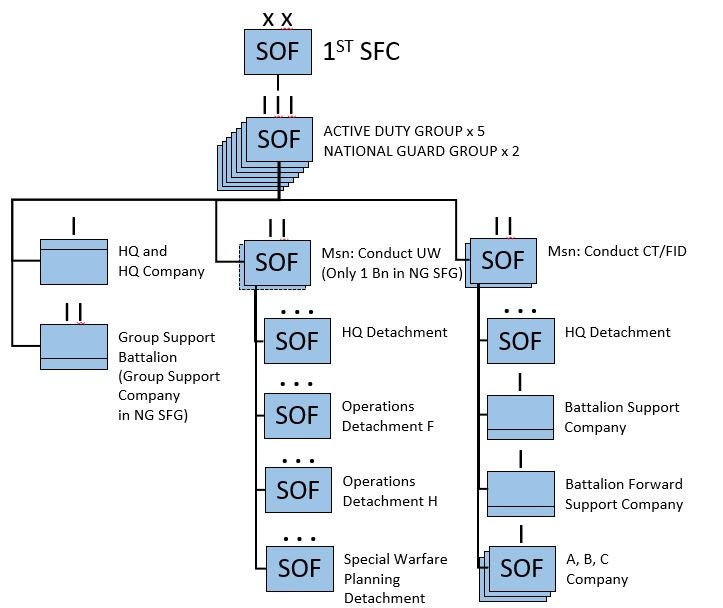
And then how is 1st Special Forces Command currently organized? The command has five active-duty Special Forces Groups and ii in the Army National Guard. Each of the active-duty groups (1st, 3rd, fifth, 7th, and 10th Group) take three Special Forces battalions of soldiers focused on counterterrorism and foreign internal defense. But one battalion is focused on unconventional warfare.
The two National Guard groups (19th and 20th Groups) have three counter-terrorism-focused battalions each and lack a dedicated anarchistic warfare adequacy. Needless to say, the current strength structure has produced a gap in special operations capabilities, despite repeated urging from Congress that U.Southward. Special Operations Command reduce its post-nine/eleven posture in favor of countering China and Russia.
Getting force structure correct
Repurposing one battalion in each Special Forces Group to focus on unconventional warfare would better align the 1st Special Forces Control with the National Defence force Strategy and its Irregular Warfare Annex while having minimal impact on readiness. The rest of the command's organization would remain unchanged.
This would then upshot in having two battalions with expertise in counterterrorism and foreign internal defense force, and two battalions ready for unconventional warfare missions. Meanwhile, National Guard Special Forces Groups would have two battalions remaining the same while converting one to unconventional warfare. Aside from this reorganization leading to better outcomes in line with national policy, this solution can be executed with existing resources: a battalion focused on unconventional warfare needs simply 215 soldiers, while a counterterrorism/strange internal defense battalion requires only over 509.
Once implemented, this conversion would reduce the 1st Special Forces Command's total manning requirements by nearly three,000 soldiers. This is specially of import given the much-lamented difficulty that all of special operations has experienced in recruiting enough new personnel to fill its manning requirements.
Still, nosotros realize there will be pushback on this recommendation. The most likely area of contention would be in gaining buy-in from the rank-and-file, as stakeholders volition point to the historically high need for counterterrorism operations and partnering with foreign forces during the Global War on Terror. Nevertheless, contempo force realignment abroad from Iraq and Afghanistan will reduce those requirements and should make a refocus toward unconventional warfare priorities both more than adequate and necessary.
The devil is in the details
Several existing processes for managing personnel and their careers will require modification. Manning and training considerations will have the greatest bear on on the successful conversion of one battalion per group to an unconventional warfare focus, as this recommendation requires the recruitment, direction, and memory of exceptional personnel who are uniquely capable of operating safely in hostile territory for extended periods of time.
Nevertheless, a reorganization would reduce the overall manning requirements for the 1st Special Forces Command while eliminating the need for both battalion support and forwards back up visitor in each grouping.
In that location will be further challenges: While 1st Special Forces Control already has one of the nearly intensive assessment and choice processes in the military, the characteristics required for anarchistic warfare further limits the pool of appropriate candidates. Additionally, the training required to develop true subject-matter experts capable of accomplishing such sensitive missions will strain the current pipeline designed to impart the required specialized skills. Implementation volition only be successful if U.Southward. Special Operations Command increases its capacity to railroad train unconventional warfare subject matter experts.
Finally, U.South. Special Operations Command must be willing to support the use of its increased unconventional warfare capability in those circumstances in which it is both appropriate and able to contribute meaningfully to broader national interests. In interagency discussions, the Defense force Department's Assistant Secretarial assistant of Defence force for Special Operations and Low-Intensity Disharmonize plays a critical role in advocating for the development, maintenance, and employment of anarchistic warfare options as the "service-like secretary" for the U.S. Special Operations Command.
Historically, other departments and agencies within the U.S. authorities have resisted the Defence force Department'southward efforts to apply indirect military machine approaches against sensitive international security challenges. Within a broader irregular warfare framework, the Defense Department tin can and should nest more robust and aggressive unconventional warfare activities to fully back up interagency approaches to our thorniest problems.
The functioning of the 1st Special Forces Command since ix/xi has been nil short of extraordinary, as soldiers take bravely served on the frontlines around the world. But to win the next fight, on the next battlefield against peer competitors, it is imperative that the command be fix, willing, and able to execute the unconventional warfare mission.
Our proposal would create Special Forces formations with the capabilities necessary to counter Mainland china and Russia while getting back to the fundamental ideal of what makes Special Forces truly "special."
It would create a Special Forces Command that is more reflective of its roots — more closely resembling the famed OSS and early Army Green Berets that stood up confronting Nazi Federal republic of germany, the Soviet Union, and other communist adversaries throughout the Cold War. Finally, it would model those Special Forces "Equus caballus Soldiers" who waged unconventional warfare to fight alongside the Northern Alliance in Afghanistan to bring about the rapid collapse of the Taliban in 2001.

This render "back to basics" volition certainly crave considered and sustained focus throughout the Department of Defence force and the Ground forces to successfully transform 1st SFC into a formation even better prepared to run into the nation's current and time to come operational requirements and meet the threat posed by China and Russia. However, the modest investment made now, during a period of reduced counterterrorism threats, will allow the force to better back up the National Defence force Strategy and Irregular Warfare Addendum.
A refocus on increased unconventional warfare capability will both allow for greater deterrence to forestall a war with People's republic of china and Russia or, failing that, provide the The states and its allies with the ways to drastically increase the cost and difficulty past which adversaries might pursue such assailment.
As President John F. Kennedy said in 1962, "There is another blazon of warfare — new in its intensity, ancient in its origin — war by guerrillas, subversives, insurgents, assassins; war by ambush instead of by combat, past infiltration instead of assailment, seeking victory by eroding and exhausting the enemy instead of engaging him," he said, his words still applicable to today'south challenges. "It preys on unrest."
The views expressed in this publication are those of the authors and do non necessarily reflect the official policy or position of the Department of Defense or the U.S. regime. The public release clearance of this publication by the Section of Defence does not imply Department of Defence endorsement or factual accurateness of the cloth.
Source: https://taskandpurpose.com/analysis/army-special-forces-back-to-basics-oped/
0 Response to "Dungeron Warfare Best Defense Agains Horses"
Mag-post ng isang Komento