Which Philosopher Introduced the Term Art World Into the Realm of Aesthetics
This is a history of aesthetics.
Aboriginal Greek aesthetics [edit]
The first important contributions to aesthetic theory are commonly considered to stem from philosophers in Ancient Greece, among which the about noticeable are Plato, Aristotle and Plotinus. When interpreting writings from this fourth dimension, it is worth noticing that information technology is debatable whether an exact equivalent to the term beauty existed in classical Greek.[1]
Xenophon regarded the beautiful as coincident with the good, while both of these concepts are resolvable into the useful. Every beautiful object is so chosen because it serves some rational finish: either the security or the gratification of man. Socrates rather emphasized the ability of beauty to further the more necessary ends of life than the immediate gratification which a beautiful object affords to perception and contemplation. His doctrine puts forward the relativity of beauty. Plato, in contrast, recognized that beauty exists as an abstract Class. It is therefore accented and does not necessarily stand in relation to a percipient listen.[2]
Plato [edit]
Of the views of Plato on the discipline, it is hardly less difficult to proceeds a clear conception from the Dialogues, than it is in the instance of upstanding good. In some of these, various definitions of the beautiful are rejected as inadequate by the Platonic Socrates. At the aforementioned fourth dimension we may conclude that Plato's mind leaned incomparably to the conception of an absolute dazzler, which took its place in his scheme of ideas or self-existing forms. This truthful beauty is nothing discoverable equally an attribute in some other thing, for these are just cute things, not the beautiful itself. Love (Eros) produces aspiration towards this pure idea. Elsewhere the soul's intuition of the self-beautiful is said to be a reminiscence of its prenatal beingness. As to the precise forms in which the thought of beauty reveals itself, Plato is not very decided. His theory of an accented beauty does not easily conform itself to the notion of its contributing just a diverseness of sensuous pleasure, to which he appears to lean in some dialogues. He tends to identify the self-beautiful with the conceptions of the true and the expert, and thus in that location arose the Platonic formula kalokagathia. So far as his writings embody the notion of any mutual element in beautiful objects, it is proportion, harmony or unity among their parts. He emphasizes unity in its simplest attribute as seen in evenness of line and purity of color. He recognizes in places the beauty of the mind, and seems to think that the highest beauty of proportion is to be constitute in the spousal relationship of a beautiful listen with a beautiful body. He had but a poor stance of art, regarding it as a pull a fast one on of fake (mimesis) which takes us some other step further from the luminous sphere of rational intuition into the shadowy region of the semblances of sense. Accordingly, in his scheme for an ideal democracy, he provided for the most inexorable censorship of poets, etc., and then equally to make art equally far as possible an musical instrument of moral and political training.[ii]
An example of Plato'south considerations most poetry is: "For the authors of those groovy poems which we admire, exercise not attain to excellence through the rules of any fine art; but they utter their beautiful melodies of verse in a country of inspiration, and, as it were, possessed by a spirit not their own."[iii]
Aristotle [edit]
Aristotle, in contrast to Plato, adult certain principles of beauty and fine art, nigh clearly then in his treatises on poetry and rhetoric. He saw the absence of all animalism or desire in the pleasure it bestows equally another feature of the cute. Aristotle finds (in the Metaphysics) the universal elements of beauty to be order ( taxis ), symmetry and definiteness or determinateness (to orismenon ). In the Poetics he adds some other essential, namely, a sure magnitude; the object should not be too big, while clearness of perception requires that it should not be too minor.[2]
Aristotle was passionate about goodness in men every bit he valued "taking [its] virtues to be central to a well-lived life."[4] In Politics, he writes, "Again, men in general desire the good, and not simply what their fathers had."[v] To thoroughly comprehend goodness, Aristotle also studied Beauty. As noted in the Encyclopædia Britannica (1902), moreover, Aristotle, "ignores all conceptions of an absolute Beauty, and at the same fourth dimension seeks to distinguish the Beautiful from the Adept." Aristotle explains that men "will be improve able to reach [their] good if [they] develop a fuller understanding of what information technology is to flourish."[4] He nevertheless seeks (in the Metaphysics) to distinguish the skillful and the beautiful by maxim that the former is always in action ( `en praxei ) whereas the latter may be in motionless things as well ( `en akinetois ). At the aforementioned time he allowed that the skilful might under certain conditions be called beautiful. He farther distinguished the beautiful from the fit, and in a passage of the Politics set up beauty above the useful and necessary.[2]
Aristotle's views on fine art distinctly recognized (in the Politics and elsewhere) that the aim of art is immediate pleasure, as singled-out from utility, which is the finish of the mechanical arts. He took a college view of artistic imitation than Plato, holding that it implied knowledge and discovery, that its objects not only comprised particular things which happen to exist, but contemplated what is probable and what necessarily exists. In the Poetics he declares poetry to exist more philosophical and serious a matter ( spoudaiteron ) than History. He gives us no complete classification of the fine arts, and it is doubtful how far his principles, due east.k. his idea of a purification of the passions past tragedy, are to be taken as applicable to other than the poetic fine art.[2]
Plotinus [edit]
Of the later Greek and Roman writers the Neo-Platonist Plotinus deserves to exist mentioned. According to him, objective reason (nous) as self-moving, becomes the formative influence which reduces dead matter to form. Matter when thus formed becomes a notion (logos), and its grade is beauty. Objects are ugly so far as they are unacted upon by reason, and therefore formless. The creative reason is absolute beauty, and is called the more than beautiful. In that location are three degrees or stages of manifested dazzler: that of human reason, which is the highest; of the human soul, which is less perfect through its connexion with a material trunk; and of existent objects, which is the lowest manifestation of all. Equally to the precise forms of dazzler, he supposed, in opposition to Aristotle, that a unmarried thing not divisible into parts might exist beautiful through its unity and simplicity. He gives a high place to the beauty of colours in which material darkness is overpowered by light and warmth. In reference to artistic dazzler he said that when the artist has notions every bit models for his creations, these may get more beautiful than natural objects. This is conspicuously a stride away from Plato'southward doctrine towards our modern conception of artistic idealization.[2]
Western medieval aesthetics [edit]

Surviving medieval art is primarily religious in focus and funded largely by the State, Roman Catholic or Orthodox church, powerful ecclesiastical individuals, or wealthy secular patrons. These fine art pieces often served a liturgical function, whether as chalices or fifty-fifty as church buildings themselves. Objects of fine art from this period were frequently fabricated from rare and valuable materials, such as gold and lapis, the price of which usually exceeded the wages of the artist.
Medieval aesthetics in the realm of philosophy built upon Classical thought, continuing the practice of Plotinus past employing theological terminology in its explications. St. Bonaventure's "Retracing the Arts to Theology", a principal example of this method, discusses the skills of the artisan as gifts given by God for the purpose of disclosing God to mankind, which purpose is achieved through four lights: the light of skill in mechanical arts which discloses the world of artifacts; which lite is guided by the light of sense perception which discloses the world of natural forms; which light, consequently, is guided by the lite of philosophy which discloses the earth of intellectual truth; finally, this lite is guided by the calorie-free of divine wisdom which discloses the earth of saving truth.
Saint Thomas Aquinas'due south aesthetic is probably the almost famous and influential theory among medieval authors, having been the discipline of much scrutiny in the wake of the neo-Scholastic revival of the late 19th and early on 20th centuries and fifty-fifty having received the approbation of the celebrated Modernist writer, James Joyce. Thomas, like many other medievals, never gives a systematic account of beauty itself, but several scholars accept conventionally arranged his thought—though not always with uniform conclusions—using relevant observations spanning the entire corpus of his work. While Aquinas's theory follows generally the model of Aristotle, he develops a singular aesthetics which incorporates elements unique to his thought. Umberto Eco'south The Aesthetics of Thomas Aquinas identifies the iii principal characteristics of beauty in Aquinas's philosophy: integritas sive perfectio (integrity or perfection), consonantia sive debita proportio (consonance or proportion) , and claritas sive splendor formae (brightness or form). While Aristotle likewise identifies the beginning two characteristics, St. Thomas conceives of the third equally an appropriation from principles developed by neo-Platonic and Augustinian thinkers. With the shift from the Middle Ages to the [Renaissance], fine art besides changed its focus, as much in its content equally in its style of expression.
Historic period of Enlightenment [edit]
Addison [edit]
Joseph Addison's "Essays on the Imagination" contributed to the Spectator, though they belong to popular literature, contain the germ of scientific analysis in the statement that the pleasures of imagination (which ascend originally from sight) fall into ii classes — (1) chief pleasures, which entirely proceed from objects before our eyes; and (2) secondary pleasures, flowing from the ideas of visible objects. The latter are profoundly extended by the addition of the proper enjoyment of resemblance, which is at the basis of all mimicry and wit. Addison recognizes, too, to some extent, the influence of clan upon our artful preferences.[2]
Shaftesbury [edit]
Shaftesbury is the first of the intuitional writers on dazzler. In his Characteristicks the beautiful and the good are combined in one ideal formulation, much as with Plato. Matter in itself is ugly. The society of the world, wherein all beauty really resides, is a spiritual principle, all movement and life beingness the production of spirit. The principle of beauty is perceived not with the outer sense, but with an internal or moral sense which apprehends the adept every bit well. This perception yields the just true delight, namely, spiritual enjoyment.[2]
Hutcheson [edit]
Francis Hutcheson, in his System of Moral Philosophy, though he adopts many of Shaftesbury'southward ideas, distinctly disclaims any independent self-existing beauty in objects. "All beauty", he says, "is relative to the sense of some heed perceiving information technology." One cause of dazzler is to be found non in a simple sensation such as color or tone, but in a certain gild amongst the parts, or "uniformity amongst variety". The faculty past which this principle is discerned is an internal sense which is divers as "a passive ability of receiving ideas of dazzler from all objects in which there is uniformity in variety". This inner sense resembles the external senses in the immediateness of the pleasure which its activity brings, and further in the necessity of its impressions: a beautiful thing beingness always, whether nosotros will or no, beautiful. He distinguishes two kinds of beauty, absolute or original, and relative or comparative. The latter is discerned in an object which is regarded as an imitation or semblance of another. He distinctly states that "an exact false may withal be beautiful though the original were entirely devoid of it." He seeks to bear witness the universality of this sense of dazzler, by showing that all men, in proportion to the enlargement of their intellectual capacity, are more than delighted with uniformity than the opposite.[2]
Alexander Gottlieb Baumgarten [edit]
Peradventure the first German philosopher who developed an independent artful theory was Baumgarten. In his best-known work Aesthetica, he complemented the Leibniz-Wolffian theory of knowledge by adding to the articulate scientific or "logical" knowledge of the agreement the knowledge of the senses, to which he gave the proper name "aesthetic". It is for this reason that Baumgarten is said to have "coined" the term aesthetics. Beauty to him corresponds to perfect sense-cognition. Baumgarten reduces gustatory modality to an intellectual act and ignores the element of feeling. To him, nature is the highest embodiment of beauty, and thus fine art must seek its supreme function in the strictest possible imitation of nature.[2]
Burke [edit]
Shush's speculations, in his Research into the Origin of our Ideas of the Sublime and Cute, illustrate the trend of English language writers to treat the problem every bit a psychological one and to innovate physiological considerations. He finds the elements of beauty to exist:-- (1) smallness; (2) smoothness; (3) gradual variation of direction in gentle curves; (four) delicacy, or the advent of fragility; (5) brightness, purity and softness of colour. The sublime is rather crudely resolved into astonishment, which he thinks always retains an element of terror. Thus "infinity has a tendency to make full the mind with a delightful horror." Burke seeks what he calls "efficient causes" for these aesthetic impressions in certain affections of the fretfulness of sight analogous to those of other senses, namely, the soothing effect of a relaxation of the nerve fibres. The arbitrariness and narrowness of this theory cannot well escape the reader's attention.[2]
Kant [edit]
Immanuel Kant'south theory of aesthetic judgments remains a highly debated aesthetic theory until today. It is important to annotation that Kant uses the term "aesthetics" ("Ästhetik") to refer to any sensual experience.[6] The work well-nigh crucial to aesthetics as a strand of philosophy is the first one-half of his Critique of the Ability of Judgment, the Critique of the Aesthetic Power of Judgment. Information technology is subdivided in two main parts - the Analytic of the Cute and the Analytic of the Sublime, just as well deals with the experience of fine art.
For Kant, beauty does non reside inside an object, but is defined as the pleasure that stems from the ″costless play″ of imagination and understanding inspired by the object — which equally a result we volition call beautiful. Such pleasure is more than mere agreeableness, since it must exist disinterested and free — that is to say independent from the object'due south power to serve equally a means to an finish. Fifty-fifty though the feeling of dazzler is subjective, Kant goes beyond the notion of ″beauty is in the eye of the beholder″: If something is beautiful to me, I as well remember that it should exist so for everybody else, fifty-fifty though I cannot testify dazzler to anyone. Kant also insists that the aesthetic judgment is always, an "private" i.e. a atypical one, of the form "This object (due east.g. rose) is beautiful." He denies that we can reach a valid universal artful judgment of the form "All objects possessing such and such qualities are cute." (A judgment of this course would exist logical, not aesthetic.) Nature, in Kant's aesthetics, is the primary example for beauty, ranking as a source of aesthetic pleasure above art, which he just considers in the last parts of the third Critique of the Aesthetic Judgment. It is in these last paragraphs where he connects to his earlier works when he argues that the highest significance of beauty is to symbolize moral good; going in this regard even farther than Ruskin.[2]
German language writers [edit]
Schelling [edit]
Friedrich Wilhelm Joseph Schelling is the first thinker to try a Philosophy of Art. He develops this every bit the third part of his arrangement of transcendental idealism post-obit theoretic and practical philosophy. (Come across also Schelling'due south Werke, Bd. v., and J. Watson, Schelling's Transcendental Idealism, ch. vii., Chicago, 1882.) According to Schelling a new philosophical significance is given to art past the doctrine that the identity of subject and object — which is half disguised in ordinary perception and volition — is but clearly seen in artistic perception. The perfect perception of its existent self by intelligence in the work of art is accompanied by a feeling of infinite satisfaction. Art in thus effecting a revelation of the absolute seems to attain a dignity non merely above that of nature just above that of philosophy itself. Schelling throws but little lite on the concrete forms of beauty. His classification of the arts, based on his antonym of object and field of study, is a curiosity in intricate organisation. He applies his conception in a suggestive mode to classical tragedy.[2]
Hegel [edit]
In Georg Wilhelm Friedrich Hegel's system of philosophy art is viewed as the commencement phase of the accented spirit. (See also Werke, Bd. x., and Bosanquet's Introduction to Hegel's Philosophy of Fine Art.). In this stage the accented is immediately present to sense-perception, an idea which shows the writer's complete rupture with Kant'due south doctrine of the "subjectivity" of beauty. The beautiful is divers as the ideal showing itself to sense or through a sensuous medium. It is said to have its life in show or semblance (Schein) and then differs from the true, which is non actually sensuous, but the universal thought contained in sense for thought. The class of the beautiful is unity of the manifold. The notion (Begriff) gives necessity in mutual dependence of parts (unity), while the reality demands the semblance (Schein) of liberty in the parts. He discusses very fully the dazzler of nature as immediate unity of notion and reality, and lays great emphasis on the beauty of organic life. Simply it is in art that, like Schelling, Hegel finds the highest revelation of the beautiful. Art makes up for the deficiencies of natural beauty by bringing the idea into clearer light, by showing the external world in its life and spiritual blitheness. The several species of fine art in the ancient and modern worlds depend on the various combinations of matter and form. He classifies the individual arts co-ordinate to this same principle of the relative supremacy of class and matter, the everyman being architecture, the highest, poetry.[2]
Dialectic of the Hegelians [edit]
Curious developments of the Hegelian conception are to be establish in the dialectical treatment of beauty in its relation to the ugly, the sublime, etc., by Hegel's disciples, east.g. C. H. Weisse and J. K. F. Rosenkranz. The most of import product of the Hegelian School is the elaborate system of aesthetics published by F. T. Vischer (Esthetik, three Theile, 1846—1834). It illustrates the difficulties of the Hegelian thought and terminology; yet in dealing with fine art it is full of knowledge and highly suggestive.[2]
Schopenhauer [edit]
The aesthetic problem is also treated by ii other philosophers whose thought ready out from certain tendencies in Kant's system, namely Schopenhauer and Herbart. Schopenhauer (see also The World every bit Will and Idea, translated by R. B. Haldane, esp. vol. i. pp. 219–346), abandoning as well Kant'southward doctrine of the subjectivity of beauty, found in aesthetic contemplation the perfect emancipation of intellect from will. In this contemplation the heed is filled with pure intellectual forms, the "Ideal Ideas" equally he calls them, which are objectifications of the will at a certain class of completeness of representation. He exalts the state of creative contemplation every bit the one in which, as pure intellect set free from will, the misery of existence is surmounted and something of blissful ecstasy attained. He holds that all things are in some degree beautiful, ugliness beingness viewed equally merely imperfect manifestation or objectification of volition. In this manner the beauty of nature, somewhat slighted by Schelling and Hegel, is rehabilitated.[2]
Herbart [edit]
J. F. Herbart struck out some other style of escaping from Kant's idea of a purely subjective beauty (Kerbach's edition of Werke, Bd. ii. pp. 339 et seq.; Bd. iv. pp. 105 et seq., and Bd. ix. pp. 92 et seq..). He did, indeed, prefer Kant's view of the aesthetic Judgment as singular ("individual"); though he secures a certain degree of logical universality for it by emphasizing the point that the predicate (beauty) is permanently true of the same artful object. At the same time, past referring the beauty of concrete objects to certain aesthetic relations, he virtually accustomed the possibility of universal aesthetic judgments (compare above). Since he thus reduces beauty to abstract relations he is known as a formalist, and the founder of the formalistic school in aesthetics. He sets out with the idea that simply relations please — in the Kantian sense of producing pleasure devoid of desire; and his aim is to determine the "artful elementary relations", or the simplest relations which produce this pleasance. These include those of will, then that, as he admits, ethical judgments are in a way brought nether an aesthetic form. His typical case of aesthetic relations of objects of sense-perception is that of harmony between tones. The scientific discipline of thorough-bass has, he thinks, washed for music what should exist done also for other departments of aesthetic experience. This doctrine of elementary relations is brought into connexion with the writer's psychological doctrine of presentations with their tendencies to common inhibition and to fusion, and of the varying feeling-tones to which these processes give rising. This mode of treating the problem of beauty and artful perception has been greatly adult and worked upwards into a complete system of aesthetics by one of Herbart's disciples, Robert Zimmermann (Asthetik, 1838).[ii]
Lessing [edit]
Gotthold Ephraim Lessing, in his Laocoon and elsewhere, sought to deduce the special office of an art from a consideration of the means at its disposal. He took pains to ascertain the boundaries of poetry and upon the ends and appliances of art. Amongst these his distinction between arts which employ the coexistent in infinite and those which utilize the successive (equally verse and music) is of lasting value. In his dramatic criticisms he similarly endeavoured to develop clear full general principles on such points as poetic truth, improving upon Aristotle, on whose didactics he mainly relies.[ii]
Goethe and Schiller [edit]
Johann Wolfgang von Goethe wrote several tracts on artful topics, equally well equally many aphorisms. He attempted to mediate between the claims of ideal beauty, as taught by J. J. Winckelmann, and the aims of dualization. Schiller discusses, in a number of disconnected essays and letters some of the main questions in the philosophy of fine art. He looks at art from the side of civilisation and the forces of human nature, and finds in an aesthetically cultivated soul the reconciliation of the sensual and rational. His letters on artful education (Uber dice asthetische Erziehung des Menschen, trans. by J. Weiss, Boston, 1845) are valuable, bringing out among other points the connexion between aesthetic action and the universal impulse to play (Spieltrieb). Schiller's thoughts on aesthetic subjects are pervaded with the spirit of Kant'south philosophy.[2]
Jean Paul Richter [edit]
Another example of this kind of reflective discussion of fine art by literary men is afforded united states in the Vorschule der Asthetik of Jean Paul Richter. This is a rather aggressive discussion of the sublime and ludicrous, which, however, contains much valuable matter on the nature of humour in romantic poetry. Amid other writers who reflect more or less philosophically on the issues to which modern poetry gives rise are Wilhelm von Humboldt, the two Schlegels (Baronial and Friedrich) and Gervinus.[ii]
Contributions past High german savants [edit]
A word may be said in conclusion on the attempts of German savants to employ a cognition of physiological conditions to the investigation of the sensuous elements of aesthetic effect, as well every bit to introduce into the report of the simpler artful forms the methods of natural scientific discipline. The classic work of Helmholtz on "Sensations of Tone" is a highly musical composition on physics and physiology. The endeavour to determine with a like degree of precision the physiological conditions of the pleasurable effects of colours and their combinations by E. W. Brucke, Ewald Hering and more contempo investigators, has so far failed to realize the desideratum laid down by Herbart, that there should be a theory of colour-relations equal in completeness and exactness to that of tone-relations. The experimental inquiry into unproblematic aesthetically pleasing forms was begun by G. T. Fechner in seeking to test the soundness of Adolf Zeising'south hypothesis that the most pleasing proportion in dividing a line, say the vertical part of a cross, is the "golden section", where the smaller sectionalisation is to the larger as the latter to the sum. He describes in his work on "Experimental Aesthetics" (Auf experimentalen Asthetik) a serial of experiments carried out on a big number of persons, begetting on this point, the results of which he considers to be in favour of Zeising's hypothesis.[2]
French writers [edit]
In France aesthetic speculation grew out of the discussion by poets and critics on the relation of modern art; and Boileau in the 17th century, the development of the dispute between the "ancients" and the "moderns" at the end of the 17th century past B. le Bouvier de Fontenelle and Charles Perrault, and the continuation of the word as to the aims of poetry and of fine art generally in the 18th century past Voltaire, Bayle, Diderot and others, not only offer to the modern theorists valuable textile in the shape of a record past experts of their artful experience, but disclose glimpses of important aesthetic principles. Yves Marie André'south Essay on Beauty was an exploration of visual, musical, moral, and intellectual beauty. A more systematic examination of the several arts (respective to that of Lessing) is to be found in the Cours de belles lettres of Charles Batteux (1765), in which the meaning and value of the imitation of nature by art are further elucidated, and the arts are classified (as by Lessing) according equally they use the forms of space or those of fourth dimension.[two]
Theories of organic beauty: Buffier [edit]
The beginning of a more scientific investigation of beauty in general is connected with the name of Pere Buffier (run into Offset Truths), form, and illustrates his theory by the human face up. A cute face is at once the most common and nigh rare among members of the species. This seems to be a clumsy way of maxim that it is a clear expression of the typical course of the species.[2]
Hippolyte Taine [edit]
This thought of typical beauty (which was adopted by Reynolds) has been worked out more recently past Hippolyte Taine. In his work, The Ideal in Art (trans. past I. Durand), he proceeds in the manner of a botanist to determine a scale of characters in the physical and moral human being. The degree of the universality or importance of a character, and of its beneficence or adaptation to the ends of life, determine the measure of its aesthetic value, and return the work of art, which seeks to represent information technology in its purity, an ideal work.[2]
French systems of aesthetics: The spiritualistes [edit]
The only elaborated systems of aesthetics in French literature are those constructed by the spiritualistes, the philosophic writers who under the influence of German thinkers effected a reaction against the crude sensationalism of the 18th century. They aim at elucidating the college and spiritual element in artful impressions, appearing to ignore any capability in the sensuous material of affording a true artful please. Victor Cousin and Jean Charles Leveque are the principal writers of this schoolhouse. The latter adult an elaborate system of the subject (La Science du boyfriend). All beauty is regarded as spiritual in its nature. The several beautiful characters of an organic body — of which the principal are magnitude, unity and variety of parts, intensity of color, grace or flexibility, and correspondence to environment — may be brought under the conception of the ideal grandeur and gild of the species. These are perceived past reason to exist the manifestations of an invisible vital force. Similarly the beauties of inorganic nature are to be viewed equally the m and orderly displays of an immaterial physical force. Thus all beauty is in its objective essence either spirit or unconscious strength acting with fulness and in society.[2]
British writers [edit]
There is nada answering to the German conception of a system of aesthetics in English language literature. The inquiries of English thinkers have been directed for the most part to such modest problems equally the psychological process past which we perceive the beautiful — discussions which are apt to exist regarded by German historians equally devoid of real philosophical value. The writers may be conveniently arranged in 2 divisions, answering to the 2 opposed directions of English language thought: (one) the Intuitionalists, those who recognize the being of an objective beauty which is a elementary unanalysable attribute or principle of things; and (ii) the Belittling theorists, those who follow the belittling and psychological method, concerning themselves with the sentiment of beauty as a circuitous growth out of simpler elements.[2]
The Intuitionists [edit]
Reid [edit]
In his Essays on the Intellectual Powers (viii. "Of Taste") Thomas Reid applies his principle of mutual sense to the problem of beauty saying that objects of beauty agree non only in producing a certain agreeable emotion, merely in the excitation along with this emotion of a belief that they possess some perfection or excellence, that beauty exists in the objects independently of our minds His theory of beauty is severely spiritual. All dazzler resides primarily in the faculties of the mind, intellectual and moral. The beauty which is spread over the face of visible nature is an emanation from this spiritual beauty, and is beauty because it symbolizes and expresses the latter. Thus the beauty of a plant resides in its perfect adaptation to its end, a perfection which is an expression of the wisdom of its Creator.[two]
Hamilton [edit]
In his Lectures on Metaphysics, Sir Westward. Hamilton gives a short account of the sentiments of taste, which (with a superficial resemblance to Kant) he regards as subserving both the subsidiary and the elaborative faculties in cognition, that is, the imagination and the understanding. The activity of the former corresponds to the chemical element of diversity in a beautiful object, that of the latter with its unity. He explicitly excludes all other kinds of pleasure, such equally the sensuous, from the proper gratification of beauty. He denies that the attribute of beauty belongs to fitness.[2]
Ruskin [edit]
John Ruskin'south well-known speculations on the nature of beauty in Modern Painters ("Of ideas of dazzler"), though sadly wanting in scientific precision, have a sure value in the history of divine attributes. Its true nature is appreciated by the theoretic faculty which is concerned in the moral conception and appreciation of ideas of beauty, and must be distinguished from the imaginative or artistic faculty, which is employed in regarding in a certain manner and combining the ideas received from external nature. He distinguishes between typical and vital beauty. The former is the external quality of bodies which typifies some divine attribute. The latter consists in "the appearance of felicitous fulfilment of function in living things". The forms of typical beauty are:-- (1) infinity, the blazon of the divine incomprehensibility; (two) unity, the blazon of the divine comprehensiveness; (3) repose, the type of the divine permanence; (iv) symmetry, the type of the divine justice; (v) purity, the type of the divine energy; and (half dozen) moderation, the blazon of government by law. Vital beauty, once again, is regarded as relative when the degree of exaltation of the function is estimated, or generic if only the caste of conformity of an private to the appointed functions of the species is taken into business relationship. Ruskin's writings illustrate the farthermost tendency to identify artful with moral perception.[2]
The analytical theorists [edit]
Home [edit]
In the Elements of Criticism of Henry Home (Lord Kames) some other attempt is fabricated to resolve the pleasance of beauty into its elements. Beauty and ugliness are simply the pleasant and he appears to admit no general characteristic of cute objects beyond this ability of yielding pleasure. Like Hutcheson, he divides beauty into intrinsic and relative, but understands by the latter the appearance of fitness and utility, which is excluded from the beautiful past Hutcheson.[ii]
Hogarth [edit]
Passing past the name of Sir Joshua Reynolds, whose theory of beauty closely resembles that of Pere Buffier, nosotros come to the articulations of another artist and painter, William Hogarth. He discusses, in his Analysis of Beauty, all the elements of visual beauty. He finds in this the following elements:-- (1) fitness of the parts to some design; (two) diversity in as many means as possible; (iii) uniformity, regularity or symmetry, which is simply beautiful when it helps to preserve the grapheme of fitness; (iv) simplicity or distinctness, which gives pleasure non in itself, but through its enabling the center to enjoy diversity with ease; (5) intricacy, which provides employment for our agile energies, leading the eye "a wanton kind of hunt"; (vi) quantity or magnitude, which draws our attention and produces admiration and awe. The beauty of proportion he resolves into the needs of fitness. Hogarth applies these principles to the determination of the degrees of beauty in lines, figures and groups of forms. Amid lines he singles out for special honour the serpentine (formed by cartoon a line once round from the base to the noon of a long slender cone).[2]
Alison [edit]
Alison, in his well-known Essays on the Nature and Principles of Taste, proceeds past a method exactly the opposite to that of Hogarth and Shush. He seeks to analyse the mental process and so finds that this consists in a peculiar operation of the imagination, namely, the menstruum of a train of ideas through the mind, which ideas always correspond to some unproblematic affection or emotion (e.grand. cheerfulness, sadness, awe) awakened by the object. He thus makes association the sole source of artful please, and denies the existence of a primary source in sensations themselves. He illustrates the working of the principle of clan at neat length, and with much skill; yet his attempt to make it the unique source of aesthetic pleasure fails completely. Francis Jeffrey's Essays on Beauty (in the Edinburgh Review, and Encyclopædia Britannica, 8th edition) are piffling more a modification of Alison's theory. Philosophical Essays consists in pointing out the unwarranted assumption lurking in the doctrine of a single quality running through all varieties of beautiful object. He seeks to show how the successive changes in the pregnant of the term "cute" take arisen. He suggests that information technology originally connoted the pleasance of colour. The value of his discussion resides more than in the criticism of his predecessors than in the contribution of new ideas. His conception of the sublime, suggested by the etymology of the discussion, emphasizes the element of peak in objects.[2]
Of the association psychologists James Factory did fiddling more towards the assay of the sentiments of beauty than re-state Alison'due south doctrine. Alexander Bain, in his treatise, The Emotions and the Will ("Aesthetic Emotions"), carries this examination considerably further. He seeks to differentiate aesthetic from other varieties of pleasurable emotion by three characteristics:-- (1) their freedom from life-serving uses, being gratifications sought for their own sakes; (two) their purity from all bellicose concomitants; (iii) their eminently sympathetic or shareable nature. He takes a comprehensive view of the constituents of aesthetic enjoyment, including the pleasures of awareness and of its revived or its "ideal" form; of revived emotional states; and lastly the satisfaction of those broad-ranging susceptibilities which we call the love of novelty, of dissimilarity and of harmony. The outcome of sublimity is connected with the manifestation of superior power in its highest degrees, which manifestation excites a sympathetic elation in the beholder. The ludicrous, over again, is defined by Bain, improving on Aristotle and Hobbes, equally the deposition of something possessing dignity in circumstances that excite no other stiff emotion.[2]
Spencer [edit]
Herbert Spencer, in his First Principles, Principles of Psychology and Essays, has given an interesting turn to the psychology of aesthetics past the application of his doctrine of evolution. Adopting Schiller's idea of a connexion between artful activity and play, he seeks to make it the starting-point in tracing the evolution of artful action. Play is defined equally the outcome of the superfluous energies of the organism: as the activeness of organs and faculties which, owing to a prolonged menses of inactivity, have become specially ready to discharge their function, and as a issue vent themselves in imitation actions. Artful activities supply a similar mode of self-relieving belch to the higher organs of perception and emotion; and they farther concord with play in not directly subserving whatsoever processes conducive to life; in being gratifications sought for their own sake only. Spencer seeks to construct a hierarchy of aesthetic pleasures according to the caste of complexity of the faculty exercised: from those of awareness upwards to the revived emotional experiences which plant the aesthetic sentiment proper. Among the more than vaguely revived emotions Spencer includes more permanent feelings of the race transmitted by heredity; as when he refers the deep and indefinable emotion excited by music to associations with vocal tones expressive of feeling built upward during the history of our species. This biological treatment of aesthetic activity has had a wide influence, some e.g. Grant Allen being content to develop his evolutional method. Yet, as suggested higher up, his theory is now recognized as taking us only a niggling way towards an acceptable understanding of our aesthetic experience.[2]
Cultural history before the 20th century [edit]
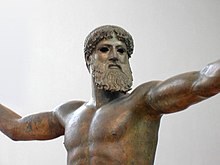
Any aesthetic doctrines that guided the production and estimation of prehistoric art are mostly unknown. An indirect business concern with aesthetics tin exist inferred from aboriginal fine art in many early on civilizations, including Egypt, Mesopotamia, Persia, Greece, People's republic of china, the Etruscans, Rome, Republic of india, the Celtic peoples, and the Maya, as each of them developed a unique and characteristic style in its fine art.
Western aesthetics [edit]
Western aesthetics usually refers to Greek philosophers equally the earliest source of formal aesthetic considerations. Plato believed in beauty as a form in which beautiful objects partake and which causes them to be cute. He felt that beautiful objects incorporated proportion, harmony, and unity amidst their parts. Similarly, in the Metaphysics, Aristotle institute that the universal elements of beauty were order, symmetry, and definiteness.

From the late 17th to the early 20th century Western aesthetics underwent a slow revolution into what is often called modernism. German language and British thinkers emphasized beauty as the key component of art and of the aesthetic experience, and saw art equally necessarily aiming at accented beauty.
For Alexander Gottlieb Baumgarten aesthetics is the science of the sense experiences, a younger sister of logic, and beauty is thus the most perfect kind of noesis that sense experience tin have. For Immanuel Kant the aesthetic experience of beauty is a judgment of a subjective but similar human truth, since all people should agree that "this rose is beautiful" if it in fact is. Nonetheless, beauty cannot be reduced to whatsoever more basic set up of features. For Friedrich Schiller aesthetic appreciation of beauty is the near perfect reconciliation of the sensual and rational parts of man nature.
For Friedrich Wilhelm Joseph Schelling, the philosophy of art is the "organon" of philosophy apropos the relation between man and nature. And so aesthetics began now to exist the name for the philosophy of fine art. Friedrich von Schlegel, August Wilhelm Schlegel, Friedrich Schleiermacher and Georg Wilhelm Friedrich Hegel also gave lectures on aesthetics as philosophy of fine art later on 1800.
For Hegel, all culture is a affair of "absolute spirit" coming to be manifest to itself, stage by stage, changing to a perfection that merely philosophy can arroyo. Fine art is the first stage in which the absolute spirit is manifest immediately to sense-perception, and is thus an objective rather than subjective revelation of beauty.
For Arthur Schopenhauer artful contemplation of beauty is the most free that the pure intellect can be from the dictates of will; here we contemplate perfection of form without whatsoever kind of worldly agenda, and thus whatsoever intrusion of utility or politics would ruin the bespeak of the dazzler. It is thus for Schopenhauer one manner to fight the suffering.
The British were largely divided into intuitionist and analytic camps. The intuitionists believed that aesthetic experience was disclosed by a unmarried mental faculty of some kind. For Anthony Ashley-Cooper, tertiary Earl of Shaftesbury this was identical to the moral sense, beauty just is the sensory version of moral goodness. For Ludwig Wittgenstein aesthetics consisted in the description of a whole civilisation which is a linguistic impossibility. Hence his viewpoint can be paraphrased equally "That which constitutes aesthetics lies outside the realm of the linguistic communication game".

For Oscar Wilde, the contemplation of dazzler for beauty's sake (augmented by John Ruskin's search for moral grounding) was more than the foundation for much of his literary career; he once stated, "Aestheticism is a search after the signs of the beautiful. Information technology is the science of the beautiful through which men seek the correlation of the arts. Information technology is, to speak more than exactly, the search afterward the cloak-and-dagger of life.".[seven]
Wilde toured the The states in 1882 spreading the idea of Aesthetics in a spoken communication called "The English Renaissance". In his speech he proposed that Dazzler and Aesthetics were "not languid but energetic. By beautifying the outward aspects of life, one would beautify the inner ones." The English Renaissance was, he said, "similar the Italian Renaissance before it, a sort of rebirth of the spirit of man".[viii]
For Francis Hutcheson beauty is disclosed by an inner mental sense, simply is a subjective fact rather than an objective one. Analytic theorists like Henry Dwelling house, Lord Kames, William Hogarth, and Edmund Shush hoped to reduce dazzler to some listing of attributes. Hogarth, for example, thinks that beauty consists of (1) fettle of the parts to some pattern; (2) multifariousness in as many ways equally possible; (3) uniformity, regularity or symmetry, which is simply beautiful when it helps to preserve the graphic symbol of fitness; (4) simplicity or distinctness, which gives pleasure non in itself, just through its enabling the eye to enjoy variety with ease; (five) intricacy, which provides employment for our active energies, leading the eye on "a wanton kind of hunt"; and (6) quantity or magnitude, which draws our attending and produces admiration and awe.[2] Later analytic aestheticians strove to link beauty to some scientific theory of psychology (such as James Factory) or biology (such as Herbert Spencer).
Indian aesthetics [edit]
The Indian aesthetics tradition traces to the Vedic era texts of Hinduism. The Aitareya Brahmana (~1000 BCE) in section vi.27, for example, states the arts are a refinement of the self (atma-samskrti).[ix] The oldest surviving consummate Sanskrit manuscript that discusses a theory of aesthetics is of Natya Shastra, estimated to have been complete between 200 BCE and 200 CE.[x] This theory is called rasa in the text. Rasa is an ancient concept in Indian arts about the aesthetic season of whatever visual, literary or musical work, that evokes an emotion or feeling in the reader or audience, just that cannot be described.[11] Co-ordinate to the Natya shastra, the goal of arts is to empower aesthetic experience, deliver emotional rasa (juice, taste). In many cases, fine art aims to produce placidity and relief for those exhausted with labor, or distraught with grief, or laden with misery, or struck by austere times.[9] Withal amusement is an effect, simply not the primary goal of arts according to Natya shastra. The main goal is to create rasa so equally to lift and transport the spectators, unto the expression of ultimate reality and transcendent values.[12] [thirteen]
The most complete exposition of aesthetics in drama, songs and other performance arts is found in the works of the Kashmiri Shaivite-Hindu philosopher Abhinavagupta (c. chiliad CE).[xi] [12] [xiii] Abhinavagupta'due south analysis of Natyasastra is notable for its all-encompassing discussion of artful and ontological questions.[14] [15]
The concept of rasa is fundamental to many forms of Indian arts including dance, music, theatre, painting, sculpture, and literature, the interpretation and implementation of a particular rasa differs between different styles and schools.[xvi] [17] [18] In Indian classical music, each raga is an inspired creation for a specific mood, where the musician or ensemble creates the rasa in the listener.[19] [20]
In the aesthetic theories of Indian poetics, its ancient scholars discuss both what is stated and how it is stated (words, grammer, rhythm), suggesting that the significant of the text and the experience of rasa are both important.[18] Amongst the most celebrated in Hindu traditions on the theory of poetics and literary works, are 5th-century Bhartrhari and the 9th-century Anandavardhana, but the theoretical tradition on integrating rasa into literary artworks likely goes dorsum to a more aboriginal period. This is generally discussed under the Indian concepts of Dhvani, Sabdatattva and Sphota.[21] [18] [22]
In the Indian theories on sculpture and architecture (Shilpa Shastras), the rasa theories, in part, drive the forms, shapes, arrangements and expressions in images and structures.[23] [24]
Chinese aesthetics [edit]
Chinese art has a long history of varied styles and emphases. Confucius emphasized the role of the arts and humanities (especially music and poetry) in broadening man nature and aiding li (etiquette, the rites) in bringing usa dorsum to what is essential about humanity. His opponent Mozi, all the same, argued that music and fine arts were classist and wasteful, benefiting the rich over the poor. Past the quaternary century AD artists had started debating in writing over the proper goals of art as well. Gu Kaizhi has left three surviving books on the theory of painting.
Several afterwards artists or scholars both created art and wrote about the creation of it. Religious and philosophical influences on art were mutual (and diverse) but never universal. Mod Chinese aesthetic theory took shape during the modernization of China from Empire to republic in early 20th century. Thus thinkers like Kant, Hegel, Marx and Heidegger accept all been incorporated into gimmicky Chinese aesthetic theory, through philosophers similar Li Zehou.[25]
African aesthetics [edit]
African art is the cultural expression of a vast and rich continent. It is the product of millennia of changes, migrations, international and intercontinental merchandise, diplomacy and cultural norms. Inside the scholarship surrounding African art, at that place is some question in using the word "art" to describe it. Malidoma and Sonbofu Somé,[26] [27] cultural emissaries of the Dagara of Burkina Faso concord that inside their culture the closest give-and-take for art is simply the give-and-take "sacred". Kongo nkisi power objects illustrate this bespeak. They are objects traded on the contemporary art market on aesthetic value, yet their purpose was to serve in rituals of personal and customs healing. Consideration is due, when viewing African cultural product, in understanding the primary part of these objects held within the cultures themselves.
At that place is a wonderful coaction between practicality and aesthetic in African material culture. Consider the Akan stool, Yoruba adire cloth and combs, or Gio spoons. Here you lot accept an example of the African genius in enlivening the most mundane object into an artful presence. Sculpture and performance art are prominent, and abstract and partially abstracted forms are valued, and were valued long earlier influence from the Western tradition began in earnest. The Nok culture is testimony to this. The mosque of Timbuktu shows that specific areas of Africa developed unique aesthetics.
Arab aesthetics [edit]

Arab art has the context of Islam, started in the 7th century, is sometimes referred to as Islamic fine art, although many Arab artists throughout time accept not been Muslim. The term "Islamic" refers not only to the faith, just to whatsoever form of fine art created by people in an Islamic culture or in an Islamic context, whether the artist is Islamic or non. Not all Muslims are in agreement on the use of art in religious observance, the proper place of art in gild, or the relation between secular art and the demands placed on the secular world to conform to religious precepts.
Islamic fine art frequently adopts secular elements and elements that are frowned upon, if non forbidden, past some Islamic theologians.[28] Although the often cited opposition in Islam to the depiction of human and animal forms holds true for religious fine art and architecture, in the secular sphere, such representations have flourished in nearly all Islamic cultures. The Islamic resistance to the representation of living beings ultimately stems from the belief that the creation of living forms is unique to God, and it is for this reason that the part of images and epitome makers has been controversial. The strongest statements on the subject of figural depiction are fabricated in the Hadith (Traditions of the Prophet), where painters are challenged to "breathe life" into their creations and threatened with punishment on the Day of Judgment. The Qur'an is less specific but condemns idolatry and uses the Arabic term musawwir ("maker of forms," or creative person) as an epithet for God. Partially as a result of this religious sentiment, figures in painting were frequently stylized and, in some cases, the devastation of figurative artworks occurred.
Iconoclasm was previously known in the Byzantine flow and aniconicism was a feature of the Judaic world, thus placing the Islamic objection to figurative representations within a larger context. As ornament, nevertheless, figures were largely devoid of whatever larger significance and maybe therefore posed less challenge.[29]
Human being portrayals can be plant in early Islamic cultures with varying degrees of acceptance by religious authorities. Man representation for the purpose of worship is uniformly considered idolatry as forbidden in Sharia law.[thirty] [31]
Arabic is written from right to left, similar other Semitic scripts, and consists of 17 characters, which, with the addition of dots placed above or below sure of them, provide the 28 letters of the Arabic alphabet. Short vowels are not included in the alphabet, being indicated by signs placed above or below the consonant or long vowel that they follow. Certain characters may be joined to their neighbours, others to the preceding one only, and others to the succeeding 1 just. The written letters undergo a slight external alter co-ordinate to their position within a word. When they stand up alone or occur at the end of a give-and-take, they ordinarily end in a bold stroke; when they appear in the heart of a word, they are ordinarily joined to the letter of the alphabet following by a minor, upward curved stroke. With the exception of six letters, which can exist joined only to the preceding ones, the initial and medial letters are much abbreviated, while the final form consists of the initial form with a triumphant flourish. The essential function of the characters, withal, remains unchanged.[32]
See besides [edit]
- Aesthetics
- Mathematics and art
References [edit]
- ^ Konstan, David (2014). Dazzler - The Fortunes of an Ancient Greek Idea. New York: Oxford University Press. pp. thirty–35. ISBN978-0-19-992726-5.
- ^ a b c d e f one thousand h i j k l m n o p q r s t u v w 10 y z aa ab air conditioning ad ae af ag ah ai Ane or more of the preceding sentences incorporates text from a publication now in the public domain:Chisholm, Hugh, ed. (1911). "Aesthetics". Encyclopædia Britannica. Vol. 1 (11th ed.). Cambridge University Press. pp. 277–289. (Encounter pp. 285–289.)
- ^ Plato. Ion Or: On the Iliad
- ^ a b Kraut, Richard (May 2001). "Aristotle's Ethics". The Stanford Encyclopedia of Philosophy . Retrieved 22 October 2013.
- ^ Aristotle. Politics. pp. Volume 2, 1269.a4.
- ^ Eisler, Rudolf. "Ästhetik". Kant-Lexikon. Rudolf Eisler. Retrieved 11 June 2015.
- ^ "Oscar Wilde" past Richard Ellman p 122, pub Alfred A Knopf, INC. 1988
- ^ Ellman, p164
- ^ a b Arindam Chakrabarti (2016). The Bloomsbury Research Handbook of Indian Aesthetics and the Philosophy of Art. Bloomsbury Academic. pp. ane–ii. ISBN978-i-4725-2430-0.
- ^ Natalia Lidova 2014. sfn mistake: no target: CITEREFNatalia_Lidova2014 (help)
- ^ a b Rasa: Indian Artful Theory, Encyclopedia Britannica (2013)
- ^ a b Susan L. Schwartz (2004). Rasa: Performing the Divine in India . Columbia Academy Press. pp. 12–17. ISBN978-0-231-13144-5.
- ^ a b Daniel Meyer-Dinkgräfe (2005). Approaches to Acting: Past and Present. Bloomsbury Academic. pp. 73, 102–106, 120, 155–156. ISBN978-1-4411-0381-nine.
- ^ Ananda Lal 2004, p. 308, 492. sfn error: no target: CITEREFAnanda_Lal2004 (assist)
- ^ Tarla Mehta 1995, pp. 22–24. sfn fault: no target: CITEREFTarla_Mehta1995 (help)
- ^ Wallace Dace 1963, pp. 249–252. sfn error: no target: CITEREFWallace_Dace1963 (help)
- ^ Rowell 2015, pp. 327–333. sfn error: no target: CITEREFRowell2015 (help)
- ^ a b c W.S. Hanley (2012). Anna-Teresa Tymieniecka (ed.). Analecta Husserliana, Ingardeniana Iii: The Performing Arts, the Fine Arts, and Literature. Springer. pp. 299–300, 295–309. ISBN978-94-011-3762-1.
- ^ Peter Lavezzoli (2006). The Dawn of Indian Music in the Westward. Bloomsbury Academic. p. 23. ISBN978-0-8264-1815-9.
- ^ Emmie Te Nijenhuis 1974, pp. 34–42. sfn error: no target: CITEREFEmmie_Te_Nijenhuis1974 (aid)
- ^ Sebastian Alackapally (2002). Being and Meaning: Reality and Linguistic communication in Bhartṛhari and Heidegger. Motilal Banarsidass. pp. 78–97. ISBN978-81-208-1803-3.
- ^ Harold K. Coward (1980). The Sphota Theory of Linguistic communication: A Philosophical Analysis. Motilal Banarsidass. pp. 17–23. ISBN978-81-208-0181-3.
- ^ Alice Boner; Sadāśiva Rath Śarmā; Bettina Bäumer (1996). The essence of class in sacred art. Motilal Banarsidass. pp. 72–78, 45–46, 57–58, 115–116, 121–122. ISBN978-81-208-0090-8.
- ^ Ariel Glucklich (1994). The Sense of Adharma. Oxford University Press. pp. 30–31. ISBN978-0-xix-508341-v.
- ^ Li Zehou
- ^ Somé, Malidoma (1999). The Healing Wisdom of Africa . TarcherPerigee. pp. 352 pages. ISBN087477991X.
- ^ Somé, Sonbofu (2000). The Spirit of Intimacy. William Morrow Publications. p. 160. ISBN0688175791.
- ^ Davies, Penelope J.E. Denny, Walter B. Hofrichter, Frima Fox. Jacobs, Joseph. Roberts, Ann M. Simon, David Fifty. Janson'due south History of Art, Prentice Hall; 2007, Upper Saddle River, New Jersey. Seventh Edition, ISBN 0-13-193455-4 pg. 277
- ^ "Figural Representation in Islamic Art". Department of Islamic Fine art. The Metropolitan Museum of Art. Oct 2001. Retrieved 23 Baronial 2021.
- ^ The Arab Contribution to Islamic Art: From the Seventh to the Fifteenth Centuries, [Wijdan Ali], American Univ in Cairo Press, 10 December 1999, ISBN 977-424-476-1
- ^ From the Literal to the Spiritual: The Development of the Prophet Muhammad's Portrayal from 13th century Ilkhanid Miniatures to 17th century Ottoman Art Archived 2007-12-01 at the Wayback Machine, [Steve Mwai], EJOS (Electronic Journal of Oriental Studies), volume 4, issue vii, p. 1–24, 2001
- ^ "Introduction to Islamic Calligraphy". CalligraphyIslamic.com. Archived from the original on 31 October 2018. Retrieved 23 Baronial 2021.

Bibliography [edit]
- Paul Guyer, A History of Modern Aesthetics, Cambridge, Cambridge Academy Press, 2014 (Vol. 1ː The Eighteenth Century; Vol. 2ː The Nineteenth Century; Vol. 3ː The Twentieth Century).
- Wladyslaw Tatarkiewicz, History of Aesthetics, The Hague, Mouton, 1970 (Vol 1ː Ancient Aesthetics; Vol. 2ː Medieval Aesthetics; Vol. 3ː Modern Aesthetics).
External links [edit]
- "Ancient Aesthetics". Net Encyclopedia of Philosophy.
- "Medieval Theories of Aesthetics". Internet Encyclopedia of Philosophy.
Source: https://en.wikipedia.org/wiki/History_of_aesthetics
0 Response to "Which Philosopher Introduced the Term Art World Into the Realm of Aesthetics"
Mag-post ng isang Komento